 ®
Doyenne Insights
AI Infrastructure is growing. How dependable is your business’s growth?
Buy-Side Insights for Growth Companies & Family Offices
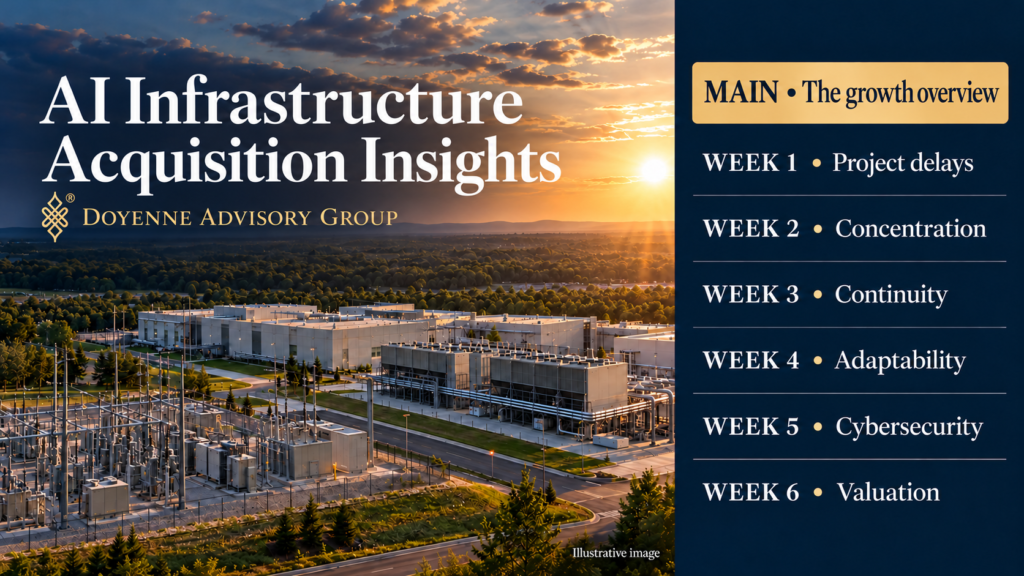 AI Infrastructure Acquisition Insights — Series Main Article
This opening article introduces Doyenne’s weekly AI Infrastructure Acquisition Insights series. Over the next six weekly installments, we will examine project timing, concentration, continuity, adaptability, cybersecurity and valuation in greater depth. Each installment will connect to this overview and the earlier discussions.
If you lead a growth company or make acquisition decisions for a family office, the expansion of AI infrastructure deserves your attention. The opportunity extends into engineering, power systems, cooling, cybersecurity, software and the services supporting those businesses.
But when we discuss that opportunity, we also need to discuss what the growth depends on.
A company can report strong revenue growth while becoming increasingly dependent on one customer, one data center or one technology provider. Its forecast may look attractive while the conditions required to deliver it remain outside management’s control.
For an owner, that affects how the business prepares for its next stage. For a buyer, it affects what the business may be worth and what ownership will require.
The project announcement is only the beginning
The International Energy Agency’s October 2026 report identifies grid constraints, electrical-equipment supply pressures, slow permitting and local opposition among the challenges facing data-center development. These pressures exist alongside substantial investment and demand.
For a company serving that development, the practical question is when an announced project becomes work that can be delivered, invoiced and collected.
Suppose your company has hired staff and ordered equipment to support a customer’s expansion. The project then moves back six months. What happens to your payroll, supplier commitments and cash position during that period?
The eventual revenue may still arrive. The business must be able to carry the delay.
At Doyenne, we would want to understand which assumptions in the growth forecast have supporting commitments and which remain dependent on someone else meeting a milestone. That distinction helps an owner plan and gives an acquisition buyer a clearer basis for evaluating future cash flow.
How much depends on one data center?
Consider a hypothetical services company that earns 60% of its revenue from work at one data-center campus.
That relationship may be profitable and longstanding. Concentration alone does not tell us whether it is a good or bad business. It does tell us where to look more closely.
What happens if the operator postpones expansion, changes suppliers or brings the work in-house? How much of the company’s profit comes from that relationship? Which costs would remain if the work stopped?
There can also be concentration beneath an apparently diverse customer list. Several customers may depend on the same campus, developer or infrastructure project.
We would encourage management to examine those shared dependencies alongside its largest individual accounts. For a family office considering an acquisition, buying several businesses serving the same development may also create more portfolio concentration than the company names suggest.
There is another side to this question. If your business uses data-center or cloud capacity to deliver its own product, how dependent is service delivery on a particular facility, region or provider?
Those are different exposures. One affects who pays you. The other affects whether you can serve your customers. A business can have both.
Continuity needs evidence
When a company says it has a backup plan, we want to understand what that means operationally.
Can work move elsewhere? Is the alternative capacity actually available? How long would recovery take, and what would customers experience while it happens?
A second provider is useful only to the extent that it provides a workable alternative. Shared infrastructure, unavailable capacity or an untested migration process can limit the protection management expects.
Associated Press reported disruption to UK banking services during an October 20, 2026 Google Cloud outage. It is a current example of shared infrastructure affecting customer service.
The same scrutiny belongs in an acquisition. A buyer needs to know which continuity arrangements exist today, which require further investment and which depend on people who may leave after closing.
Doyenne helps connect those findings to the ownership decision. A material dependency may change the transition plan, required spending or conditions for proceeding.
Adaptability has a cost. So does standing still.
AI infrastructure demand is not a promise that every business serving it will remain competitive.
Berkeley Lab’s June 2026 data-center energy report models different outcomes based on factors including equipment shipments, AI-chip operating life and server utilization. That uncertainty is a reason to test business assumptions rather than treat one industry forecast as a guaranteed revenue path.
For a founder, the question becomes specific: Can the company serve the work its customers are likely to require next?
An engineering or cooling business may need new qualifications, equipment or skills. A software company may need to adapt its product or its reliance on outside AI providers.
Dina Genkina’s IEEE Spectrum reporting on liquid cooling explores competing approaches to handling AI hardware’s heat. For an owner or buyer, that raises a practical question: which capabilities will customers require, and can this business deliver them?
Updating carries implementation costs and disruption risk. Delaying may leave the business unable to compete for work included in its forecast.
For a buyer, both belong in the analysis. Historical earnings do not explain how much investment will be needed to sustain them.
Cybersecurity belongs in the operating discussion
Cyber exposure also extends beyond the company’s own email and customer database.
International guidance published in January 2026 addresses the growing connections between operational technology, business systems, vendors and remote-access tools. It recommends controlled and monitored access, limited exposure and plans to isolate vital systems.
That matters to businesses maintaining power, cooling and other connected equipment. It also matters to buyers acquiring those businesses.
Who can access customer systems? How is that access removed when someone leaves? If a supplier is compromised, what could the company have to disconnect—and could it continue delivering its services?
For AI-enabled businesses, we would also ask what happens if a model provider changes its service, pricing or availability. NIST’s Generative AI Profile recommends monitoring third-party AI risks and planning for incidents and disengagement.
Qualified specialists need to examine the technical evidence. Management and the buyer then need to understand its commercial consequences.
What does this mean for valuation?
Our view is that these issues should reach the valuation discussion through identifiable business consequences.
A delayed project can move cash receipts into a later period. Customer concentration can make future earnings less dependable. Required technical upgrades can increase spending. Weak recovery arrangements can expose the business to interruptions and customer losses.
Those findings may affect forecast earnings, cash flow, the price a buyer will support or the terms on which it will proceed. There is no universal discount for being dependent on one data center, and sector growth does not establish an automatic valuation premium.
The evidence matters.
For CEOs and founders, documenting dependencies and addressing material weaknesses can strengthen the business before a transaction is contemplated. For family offices, the same work helps distinguish an attractive sector from an acquisition suited to their objectives and operating capacity.
At Doyenne, we connect these questions to M&A Readiness and acquisition strategy. We help owners and buyers understand what supports the growth, what could interrupt it and what needs to change to make the ownership plan workable.
If AI infrastructure is becoming a larger part of your revenue or acquisition plans, one useful place to begin is this:
Which assumption, if it changed tomorrow, would have the greatest effect on the business?
Continue the discussion with Doyenne. Our next article examines project delays and cash flow. Weekly installments will then address concentration, continuity, adaptability, cybersecurity and valuation. This overview will serve as the series guide, with links added as each article is published.
Sources and further reading
- International Energy Agency — Powering Artificial Intelligence — October 14, 2026.
- Lawrence Berkeley National Laboratory — United States Data Center Energy Usage Report: 2025 Update — Published June 2026.
- UK NCSC and international partners — Secure connectivity principles for Operational Technology — January 2026; Australian publication January 15, 2026.
- NIST — Artificial Intelligence Risk Management Framework: Generative Artificial Intelligence Profile — July 2024; NIST AI 600-1.
- Associated Press — Google Cloud outage hits UK banks — October 20, 2026; checked October 26, 2026.
- Dina Genkina — IEEE Spectrum — Next Gen AI Needs Liquid Cooling — November 2025 print issue.